

This article first appeared in Vision Capital Fund’s Q3 2026 Quarterly Letter.

This is something I have been reflecting on a lot. Traditional value investing teaches that prices matter. It is far better to buy something cheap than expensive. The larger the margin of safety, the better. Low prices (valuations) are far more desirable than high prices (valuations). When prices recover from oversold levels and mean-revert, returns become very attractive.
However, this critically assumes the underlying asset’s fundamentals remain unchanged. While price narratives can inaccurately drive business narratives (especially for commentators) in the short term, business narratives actually drive price narratives over the long term.
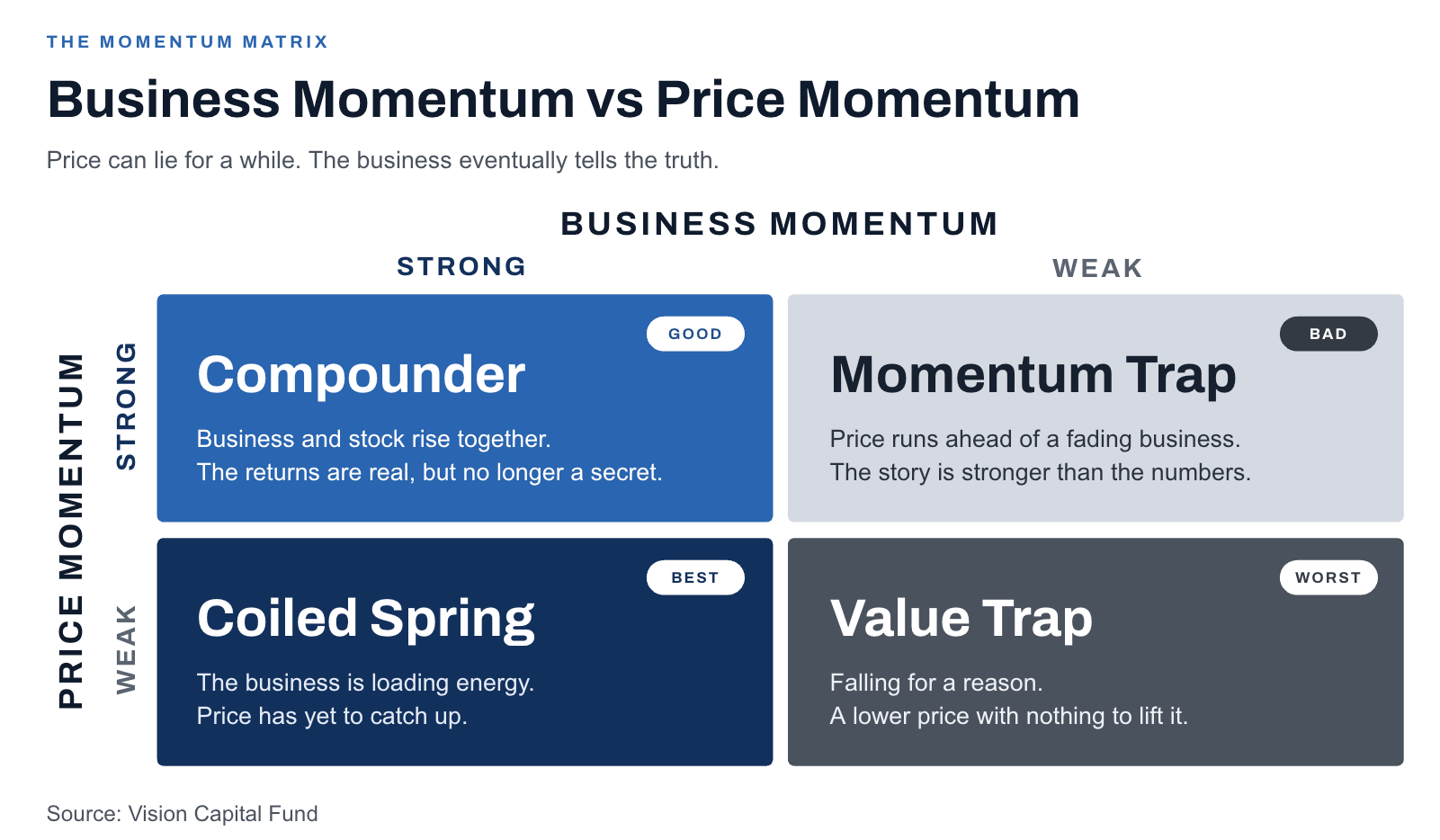
Beyond first-order thinking, we can add business momentum to price momentum and use a two-by-two matrix to frame our mental model of picking winners and avoiding losers.
Let’s take some cues from physics. Why momentum? First, momentum is dynamic, not static. A level tells us where a business currently stands. Momentum shows us where a business has gone and where it is going.
Second, momentum carries weight. In physics, momentum is mass times velocity. A business has both. Its scale and quality are its mass, and its ability to reinvest and grow is its velocity. Speed alone is insufficient. A small business can be stopped by a bad quarter. A large one growing fast is a freight train that is hard to stop. This is why we prefer to own businesses riding large secular tailwinds, with strong competitive advantages, run by strong management, and emerging as the top dogs in winner-take-most market structures. But mass works both ways. Once a heavy business slows, it is just as hard to restart.
Third, momentum tends to persist. Newton’s first law says a body in motion stays in motion unless a force acts on it. While we don’t expect every quarter or year to be exceptionally strong, good businesses tend to keep improving and stay strong. Weak businesses eventually show cracks and tend to keep getting weaker.
Fourth, momentum only changes when a force acts on it, causing it to accelerate or decelerate. Newton’s second law says force is what changes momentum. Momentum does not just slow down on its own. Something has to stop it. This is key to understanding the forces at play (e.g., competition, saturation, law of large numbers, product innovation, change in management, etc.), where they are headed, and how to position ourselves before prices reflect it.
The four losers (Paycom Software, PayPal, Lululemon, and The Trade Desk) we exited share one pattern. When revenue growth structurally decelerates and fails to reaccelerate, past high growth is unlikely to return. It becomes a one-way freight train that is hard to reverse.
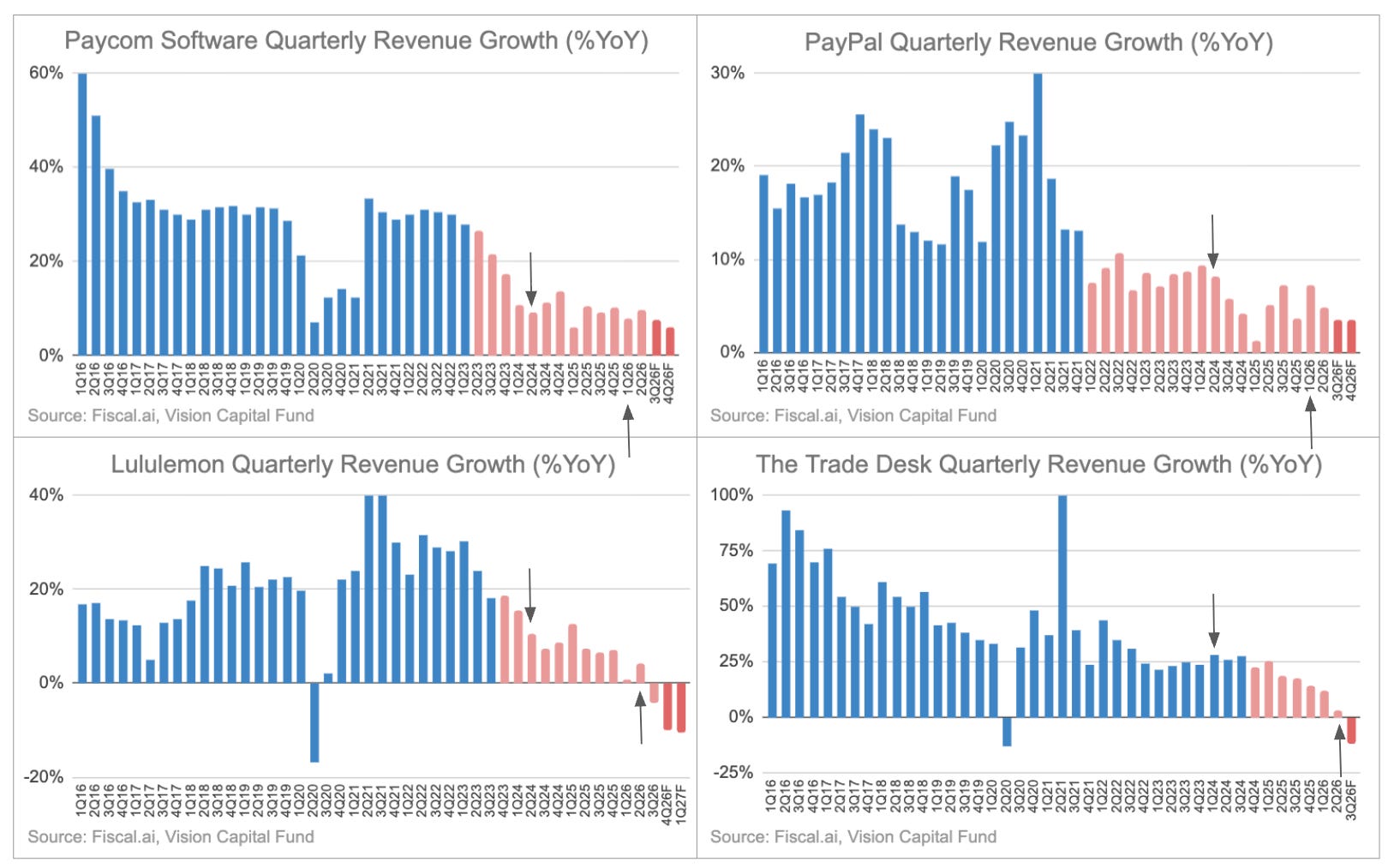
The newer, bigger realization is that (business) momentum tends to persist positively or negatively. Momentum seldom reverses, which is why turnarounds seldom turn. That became increasingly evident in these four companies, and when we saw fundamentals keep deteriorating, and growth drift into single digits, we cut our weeds and watered our flowers and new seeds instead.
Going back to our business-versus-price momentum matrix.
We far prefer the two leftmost quadrants, with strong business momentum, to the two rightmost quadrants, with weak business momentum. Most of our positions are compounders, which generally have strong business momentum and strong price momentum.
Occasionally, Mr. Market provides excellent opportunities for coiled springs, but they are the exception, not the norm. Coiled springs offer the best returns, but they are the rarest and the hardest to verify. There is some risk that Mr. Market knows something and starts to heavily discount the stock before the quarterly financials reflect it, so one needs to tread more cautiously. We are long-term buy-and-hold investors, see coiled spring opportunities as bonuses, and prefer to focus less attention and capital on this strategy.
Momentum traps are typically easier to avoid when weaker business trends are more evident, especially over time. But they are harder to avoid around pivot points, when business momentum starts to show cracks, while positions are still sized normally, as one might think it is temporary or the long-term fundamentals remain intact.
Value traps look “cheap,” then get “cheaper” as the business keeps deteriorating. That was the case for Paycom Software, PayPal, and Lululemon, which backfired. Like most turnarounds that don’t turn, cheap, deteriorating businesses stay cheap for a reason. After making these errors, we have learned to avoid such trades.
That said, we still have two “slower” growers: Meituan and JD.com. Both were hit hard by China’s food delivery wars, which led to massive subsidies that weighed on Meituan’s growth and overall industry profitability. However, subsidies peaked in 3Q25, and Meituan’s revenue growth has accelerated since, alongside improving profitability. Meituan is looking less like a value trap and more like a coiled spring.
While JD.com’s profitability has improved similarly, its short-term revenue growth was weighed down more by temporary tough comps from China’s electronics and appliances trade-in program (2Q26 vs 2Q25), and revenue growth is expected to reaccelerate. We remain optimistic about faster-growing 3P GMV, high-margin advertising, and supermarkets, as improved operating leverage continues to expand profit margins.
The difference is that the force on Meituan and JD.com is temporary (not sustainable): a food-delivery subsidy war and tough comparisons. The force on our four exits was more structural. When the whole industry slows, wait. When only your company slows, worry.
The quadrants are not fixed. A compounder that loses business momentum becomes a momentum trap, and when the price follows, it becomes a value trap.
Take The Trade Desk, for example. We thought it was a compounder. Its co-founder and CTO, Dave Pickles, stepped down in September 2023 before we bought, and we underestimated the impact. Internal product development soon slowed, and Kokai’s product rollout struggled. As revenue growth continued to decelerate against still-strong industry growth, it became a value trap we no longer want to own. Follow the business momentum, not price.
In investing, we are bound to make mistakes. Most importantly, we have to learn from them and avoid repeating them. The good thing? If a stock is going to be a multi-bagger winner, a little is all you need. If not, and it is a loser, a little is all you want.
We initially sized Lululemon and The Trade Desk larger, and they ended up amongst our largest losers. Thankfully, as business momentum waned and fundamentals deteriorated, so did our conviction. We did not double down or chase them significantly with more capital. We deployed most of our new capital to other positions with stronger business momentum where we had higher convictions.
While the losses from our losers hurt, the gains from our multi-bagger winners (>>100%) more than sufficiently offset our losers (capped at -100%). To date, gains from our top 5 winners were ~2X the total combined losses from our losers. If we continue to do it right, our slugging average (total gains/total losses) of ~2.5X should grow over time, zig-zagging through various market ups and downs.
To be clear, we are not momentum investors. They buy the stock because its price is rising and sell when it stops. We buy because we think the business can keep growing strongly, and we sell when growth structurally decelerates.
Most of our returns come from the growth of the business we own, not from buying cheap and waiting for valuations to recover. Price still matters to us, but it comes second. We remain long-term owners of businesses.
We used to ask if a stock was cheap. Now we ask if the business is still growing strongly.

“A Body in Motion”
The information contained in this article is for general informational purposes only. While every effort has been made to ensure the accuracy and reliability of the content, errors or omissions may occur. The author and publisher do not assume any responsibility or liability for any errors, inaccuracies, or omissions in the content, nor for any actions taken based on the information provided. Readers are encouraged to verify any information before relying on it and to seek professional advice as needed.

24 Oct 2026 | Eugene Ng | Vision Capital Fund | eugene.ng@visioncapitalfund.co
Find out more about Vision Capital Fund.
Read our annual and quarterly letters for Vision Capital Fund.
Check out our book on Investing, Vision Investing: How We Beat Wall Street & You Can, Too. We believe that individual investors can outperform the market over the long term. The book chronicles our entire investment approach. It explains why we invest the way we do, how we invest, what we look for in companies, where we find them, and when we invest. Available via Amazon: paperback and eBook.
Join our email list for more investing insights. Our emails tend to be ad hoc and infrequent, as we aim to write timeless, not timely, content