


The average investor made money. The average investor also does not exist. There is no average investor. There is only you, your portfolio, your decisions, and your one path through time. Finance forgot that. Ergodicity remembers it.
I came across ergodicity through the work of Ole Peters, Nassim Taleb’s writing, and Luca Dellanna’s book. The more I studied it, the more I realized it had profound implications for how we invest, manage risk, and think about survival and compounding over time. This article is my attempt to bring that idea to life.

Questions on Ergodicity that we seek to address:
What is Ergodicity? Why is Ergodicity relevant?
What is the Ensemble Average, and how does it differ from the Time Average?
Examples of Ergodicity or Non-Ergodicity in real life?
Is Investing Ergodic or non-Ergodic?
What are the implications of Ergodicity for Investors?
Act I: The Diagnosis (most systems are non-ergodic, and finance pretends otherwise)
A system is ergodic if the average outcome over many people (ensemble average) equals the average outcome of a single person over time (time average). When those two diverge, the system is non-ergodic, because you are not the group.
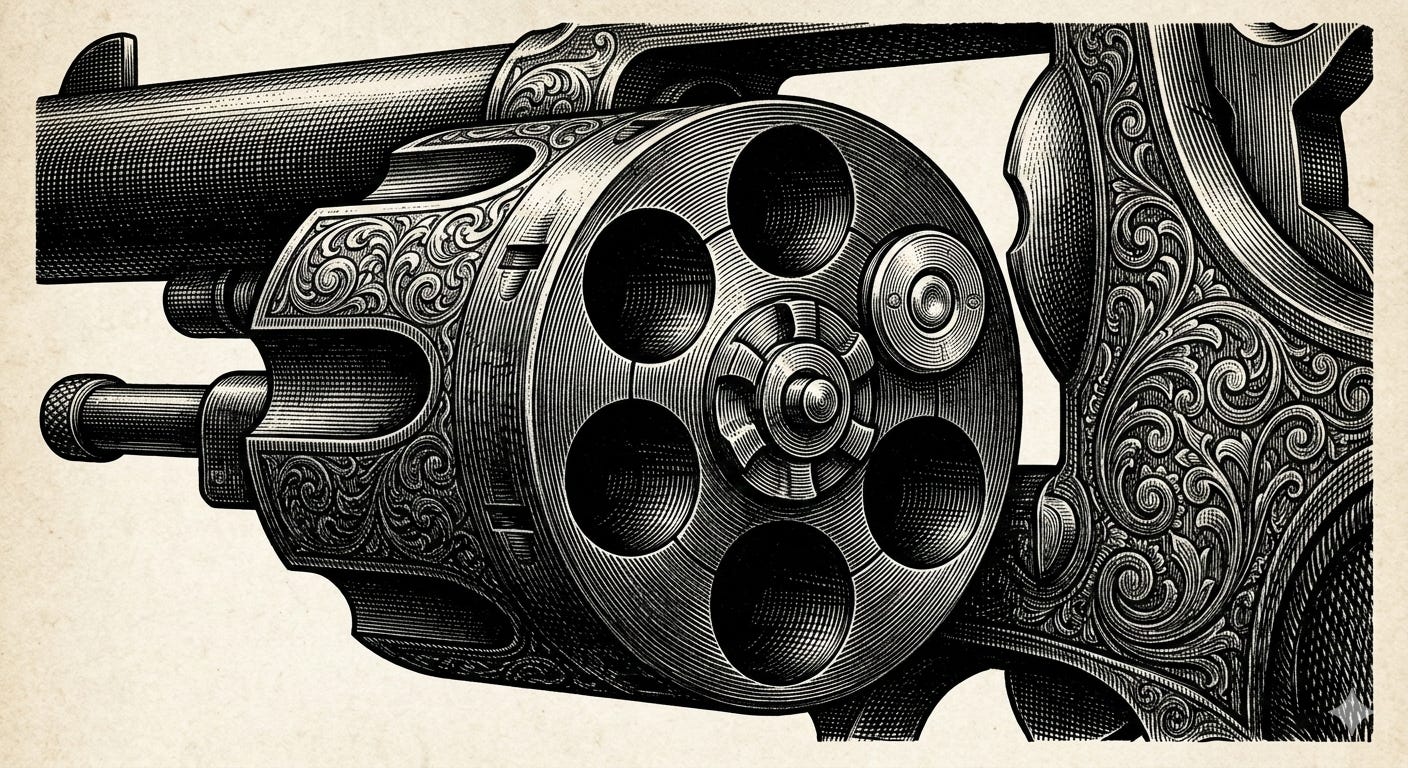
Imagine 100 people each play Russian Roulette once. One bullet, six chambers in a pistol, spin the chamber, and fire the pistol. Survivors get a huge prize. The group average survival rate looks seemingly acceptable (83% = 1 - 1/6). That is the ensemble average. The expected value is 0.833 (5/6 x 1 + 1/6 x 0). A classical economist would say, positive expected value, rational to play. If the prize is $1 mil, $10 mil, or $100 mil, does the size of the prize matter? Would you still play such a game?
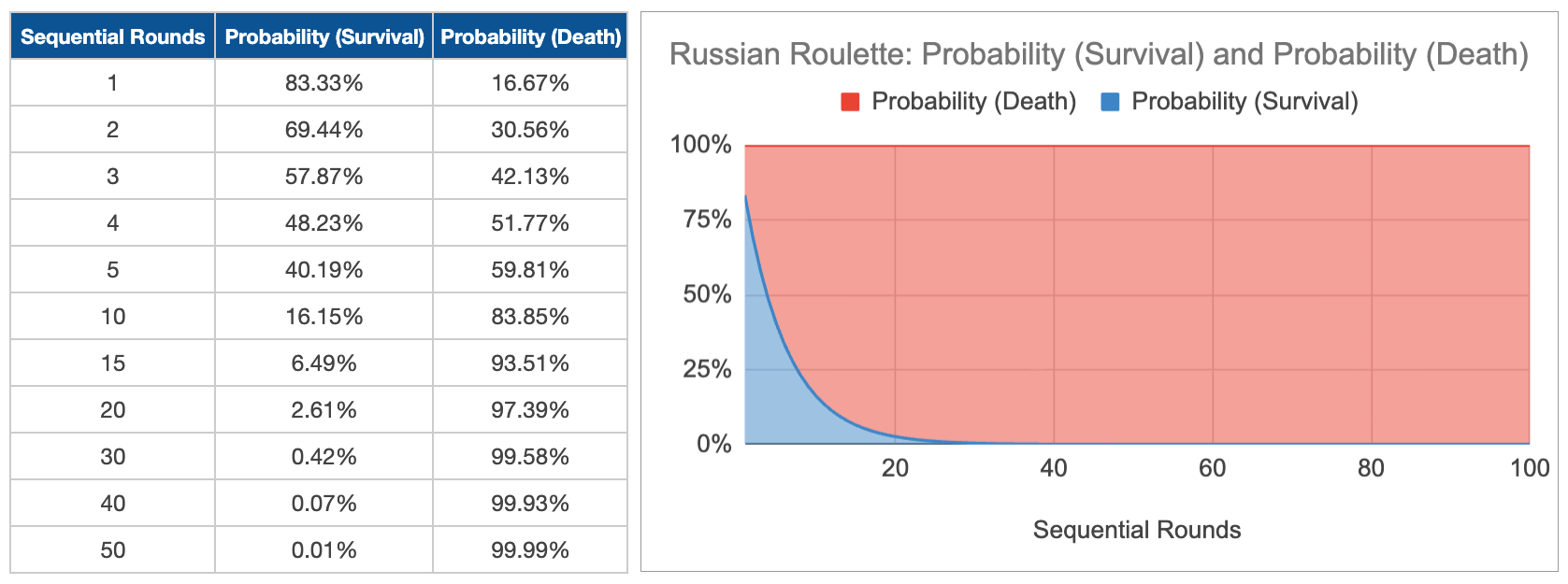
Now, imagine that one person can only play 100 rounds of Russian Roulette sequentially. They are dead with near certainty (~99.999999%). While in round 1, the probability of death is 16.7% (i.e., 1/6), which rapidly increases as more rounds are played. Probabilities grow rapidly to 60%, 84%, 97%, 99% after 5, 10, 20, 30 rounds, respectively. This is the time average.
It’s the same game, but over time results in a completely different outcome. What good is the prize if you are not alive to collect it?
Ergodic: Ensemble Average = Time Average
Non-Ergodic: Ensemble Average ≄ Time Average
History of Ergodicity.
Let’s go back. The word ergodicity comes from the Greek words “ergon” (work) and “odos” (path). Literally: the path of work.
Ergodicity was born in physics, specifically in statistical mechanics.
Ludwig Boltzmann (1870s) introduced the “ergodicity hypothesis” while trying to explain the behaviour of gas molecules.
His problem was how to predict the behaviour of trillions of gas molecules? His solution was to assume that averaging over all molecules at a given moment was equivalent to following a single molecule over time.
Henri Poincaré and mathematicians (early 1900s) began formalizing and questioning Boltzmann’s hypothesis. George Birkhoff and John von Neumann (1931) both independently proved the first rigorous ergodic theorems, giving ergodicity a firm mathematical foundation.
Ole Peters (2009 onwards) argues that economics has been applying ergodic assumptions to fundamentally non-ergodic systems.
Economic theory, at its core, focuses on utility maximisation subject to a budget constraint, without considering the possibility of total ruin over time.
Ergodicity economics postulates that individual agents should maximise the time-average growth rate of wealth rather than the expected value of wealth or the utility of wealth.
Here is the problem. Let’s return to our game of Russian Roulette. Expected value (i.e., 0.83 = 5/6 1 + 1/6 * 0) treats death as just another weighted outcome in the average. It simply assigns a number (i.e., 0) to an irreversible, permanent, non-repeatable event when a bullet is finally fired, and folds this into a calculation as if it were recoverable.
Death is not a bad outcome that you can average away. It is a game-over. It permanently removes you from all future rounds. This is exactly the ergodicity problem. Most human systems and finance assume ergodicity, that ensemble and time averages are the same, when they are not. This is what most of finance does with risk.
Finance typically assumes smooth compounding over time, but in practice, the sequence of returns matters because volatility tends to cluster. Do not trust advice about a non-ergodic system that assumes ergodicity.
Act II: Survival First (remove the left tails before anything else)
You need to survive the short run to enjoy the long run. There are decades when nothing happens and weeks when decades happen. It is not about being ergodic during decades in which nothing happens, but if it is ergodic in the weeks in which decades happen.
When you consider an investment or a decision in life, don’t just consider the average, but also the distribution of outcomes over time. Treating non-ergodic processes as if they were ergodic poses a risk of eventual ruin.
Always think about the different paths of parallel universes through time.

Maximize growth that first conserves survival. Game-overs cause non-ergodicity. Do not maximise growth over survival. When permanent game-overs are possible, don’t rely on averages. Focus on not being wiped out permanently first.
Avoid a total loss and irreversibility at all costs. Never allow a single negative event to maximise short-term returns, rendering long-term maximisation irrelevant. If you are going to play a game where, after many rounds, you are almost certainly going to be dead. Avoid playing all games that are not repeatable at infinity.
Eliminate all unlimited downside (of permanent irreversible loss) to as much as you possibly can. You don’t want to lose it all. If there is any chance of blowing up, you will eventually.
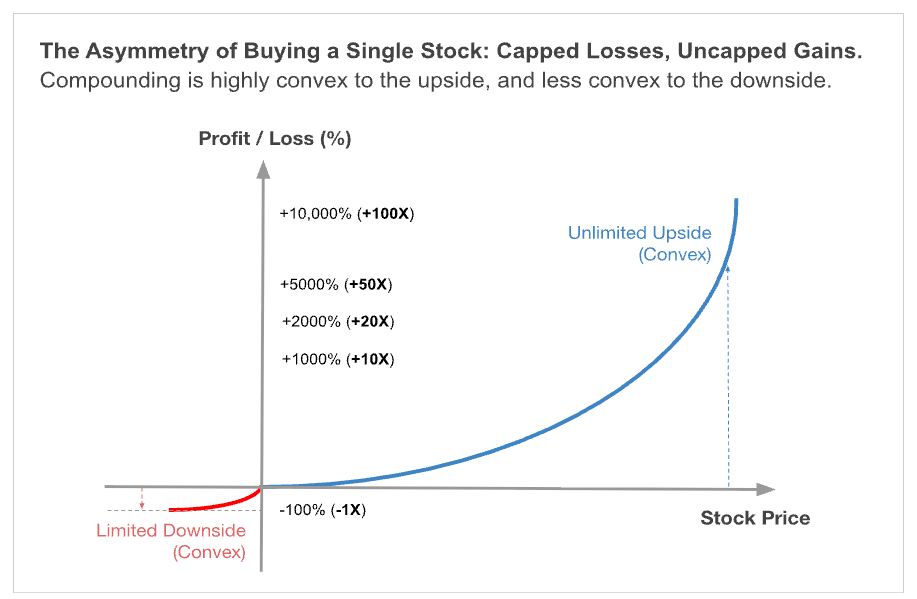
The sweet spot: remove the left tails, so you can enjoy the right tails. Seek asymmetry by limiting your downside and increasing your upside significantly.
Survival beats performance. Performance is always subordinate to survival. The longer the time horizon, the more true this becomes. To be among the best over time, you need to keep playing the game, rather than being kicked out.
Focus on being antifragile, not fragile. To determine whether something is fragile or antifragile, expose it to volatility and see how it responds. Fragile things are harmed by volatility, and antifragile things benefit from volatility. Fragility is non-ergodic. Antifragility is ergodic. Fragility has limited upside and unlimited downside. Antifragility has a limited downside and unlimited upside.

In investing, we choose to avoid unlimited downside. margin/leverage, selling options, short-selling, extreme concentration (<5-10 stocks), and duration mismatch (short-term capital chasing long-term returns). It is not about getting rich fast and then getting wiped out, but about growing and staying rich for a long time.
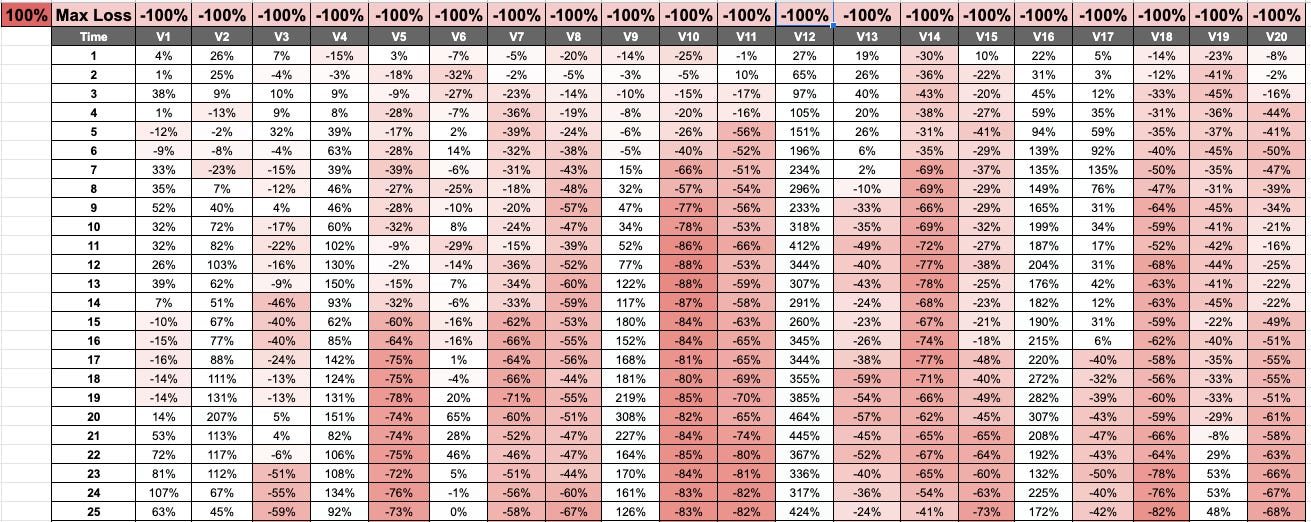
We avoid margin/leverage at all costs. Brokers can offer up to 100x leverage, but never take it. A 1% move against you could wipe you out. A Monte Carlo simulation of 20 sequential scenarios with 20X leverage, using 8% p.a. returns and 18% annualized volatility, shows that ~90-100% of the time, one will eventually be permanently wiped out (with a cumulative loss of -5%).
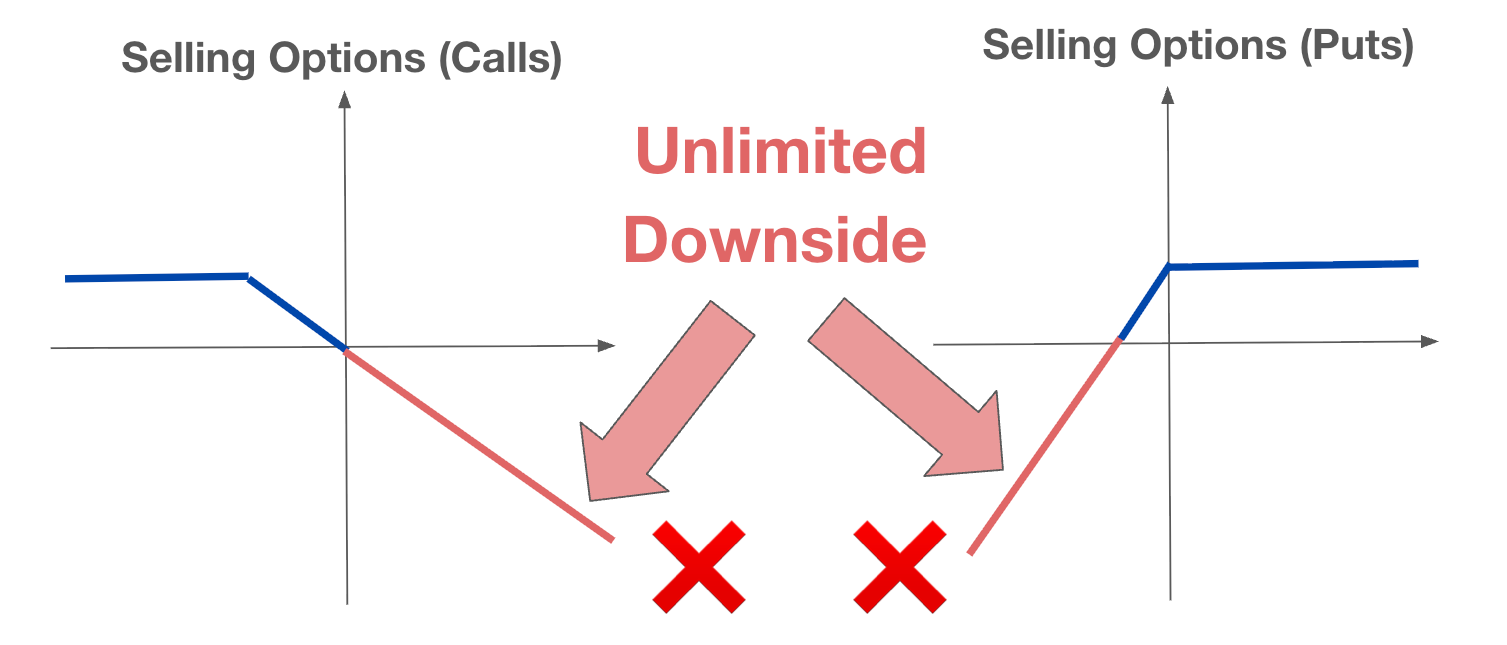
Selling options is simply not what we do. The selling of calls or puts results in unlimited downside (see payoff diagrams below).
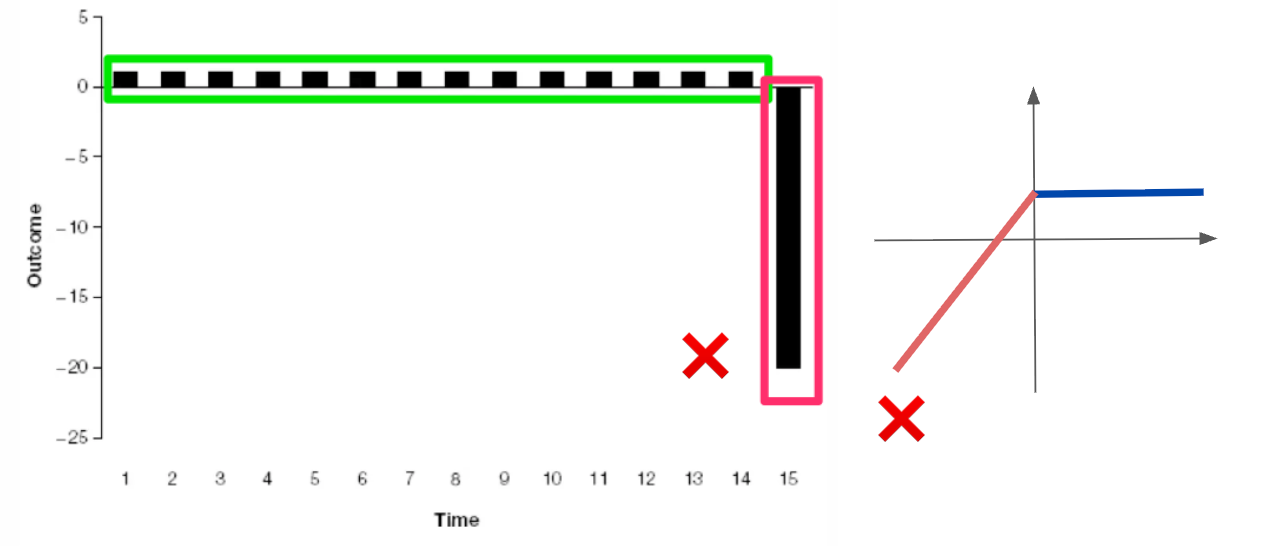
It is not about getting the small premiums when markets are doing well. When markets inevitably fall, the huge losses are significantly larger than all the small gains one received previously. This reminds me of when I tend to see more “option investing course” ads on YouTube and Facebook when markets are doing well. And then, when markets crash, most of these participants get wiped out, and when markets recover, a brand-new set of foolish participants come along again for the ride.
The presence of irreversibility doesn’t imply that you should not take any risk. Recognise and acknowledge non-ergodicity, take and size risks appropriately, so that being wrong never wipes you out permanently.
Act III: Let the Right Tails Run (once you survive, compound aggressively)
Focus on long-only stock investing, finding durable compounders that can keep growing and reinvest for a long time. The average daily return of investing in the stock market is slightly above zero, and slightly better than the odds of a coin toss (i.e., 52% ensemble average), but the time average of holding stocks over decades would be much higher historically at 88-100% probability (time average) of making money.

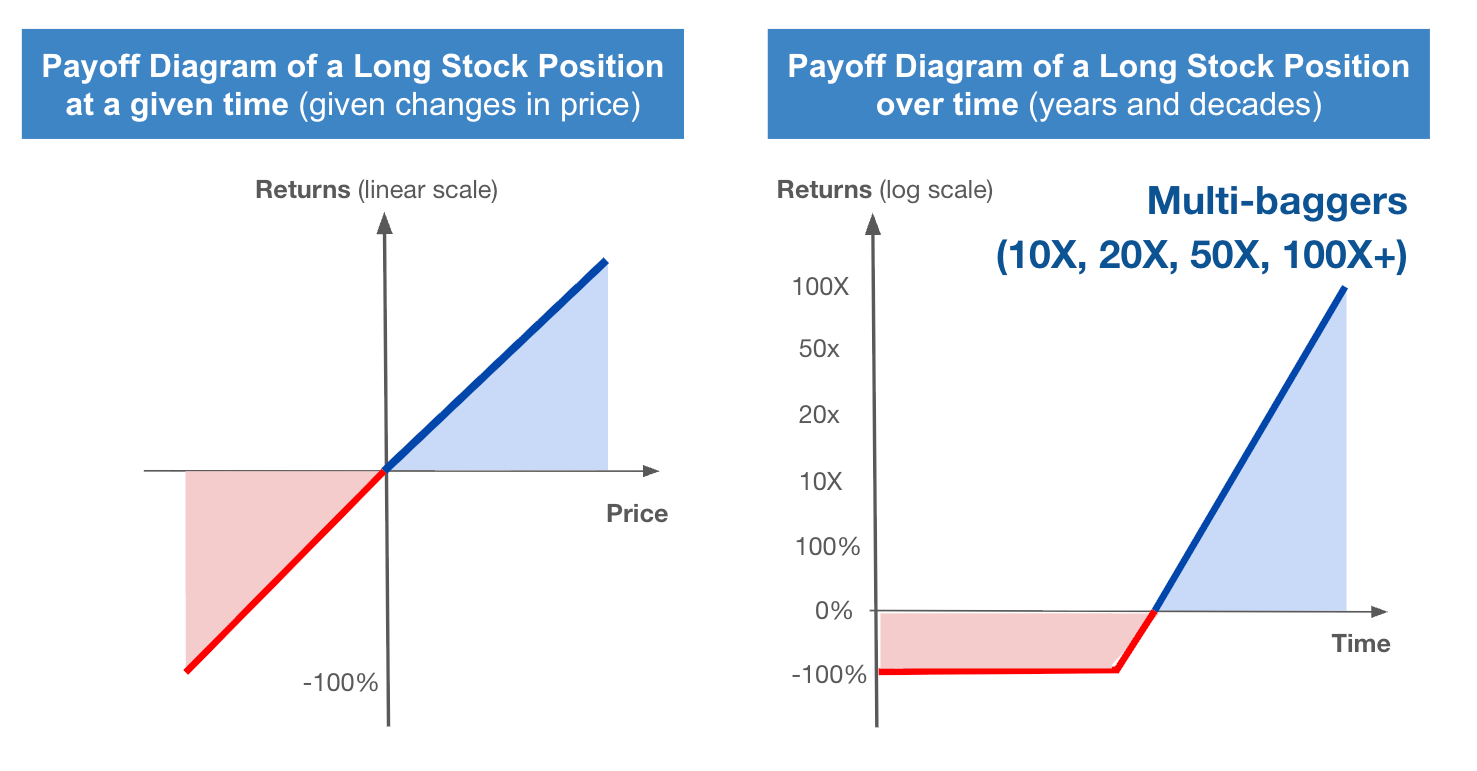
Have a process to increase your likelihood of picking winners and avoiding losers. Like in venture capital, power laws also exist in public stock markets. Bessembinder’s 2020 study found that ~1% of ~63,000 companies over 1990-2020 globally accounted for ~90% of total net returns. The majority of stocks (>55%) lost money. Individual stocks are deeply non-ergodic. The winners matter. Find them early, hold them for a long time, and if you get a few right, they will become a large allocation of your holdings and account for the majority of returns, offsetting most of the losses combined. Adopt a barbell approach. Allow for greater risk in smaller positions with greater upside. That said, once the winners become overly large, then consider trimming them to a position that you will be comfortable with.
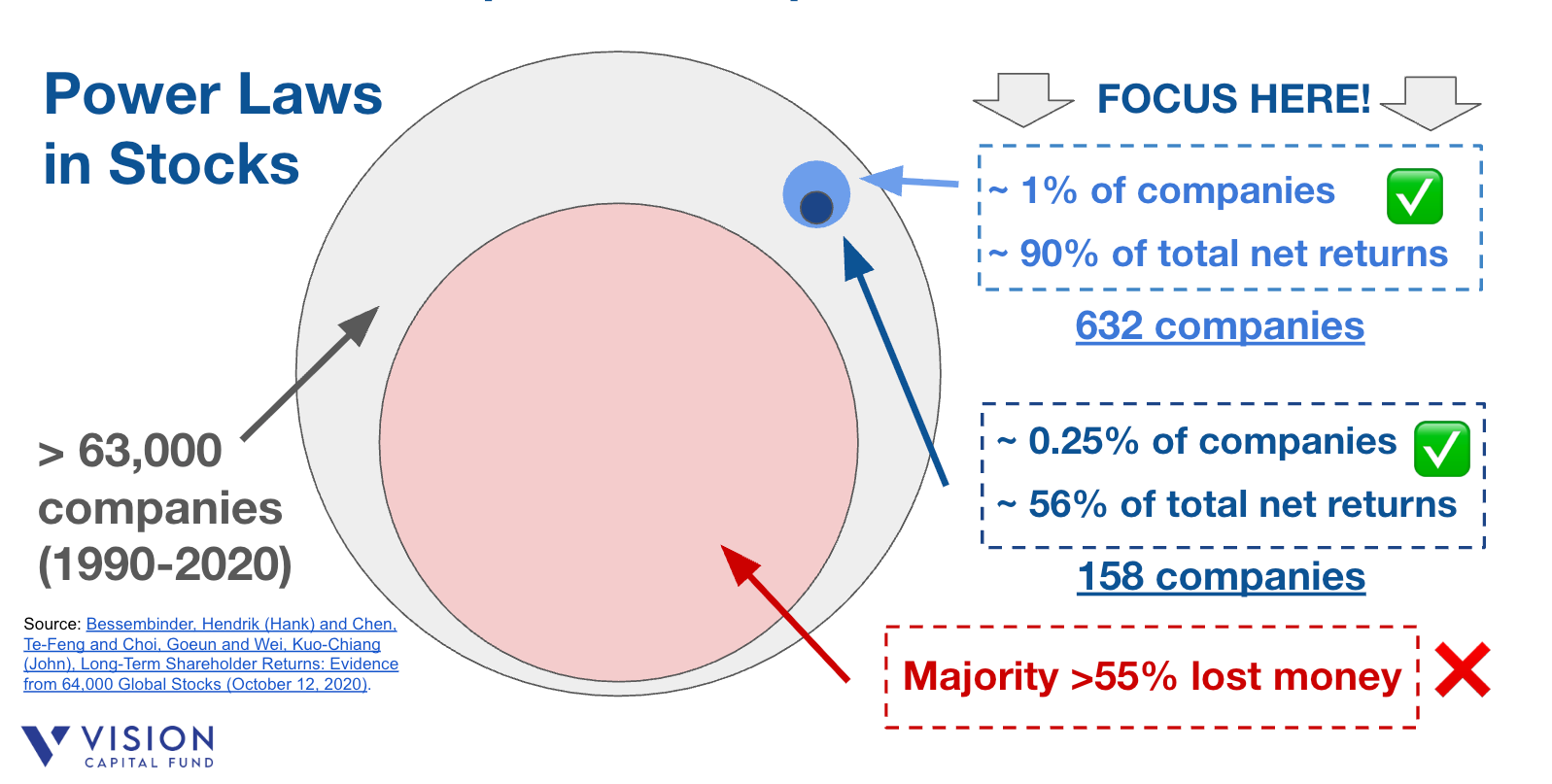
Diversification as a process, concentration as an outcome. Individual stocks are deeply non-ergodic. Companies can go to zero permanently. One bad bet, held in concentration without process, can end the game. Sufficient diversification at the portfolio level reduces non-ergodicity. It shrinks the left tail. It makes permanent ruin less likely. While the sequence of returns never fully disappears, the longer you hold a diversified portfolio and let your winners run, the higher the probability that positive returns converge towards certainty (100%).

Don’t agree with redistribution, particularly for investing. Trimming your winners to feed your losers is incorrect, as it assumes the same likelihood of returns. Winners tend to keep winning, and losers tend to keep losing. Persistence tends to be more likely at both the right tails (winners) and left tails (losers). As long as the risk is overly significant, one should first let your winners run high, second, don’t trim them, and third, add to them.
Don’t aim to be the best in any given year. Aim to be among the best you can be. To be number one, you need to have great skill and great luck. Aim to be amongst the best over time, where the contribution from skill will increasingly outweigh the contribution from luck. Being the best involves having the most skill and the most luck. Unfortunately, luck is largely outside our control. In the short term, the fewer the flips, the more likely it is to differ from its expected value (i.e., luck). Over the long term, the more flips, the more likely the average of the observed results will converge closer to the expected value (i.e., skill).
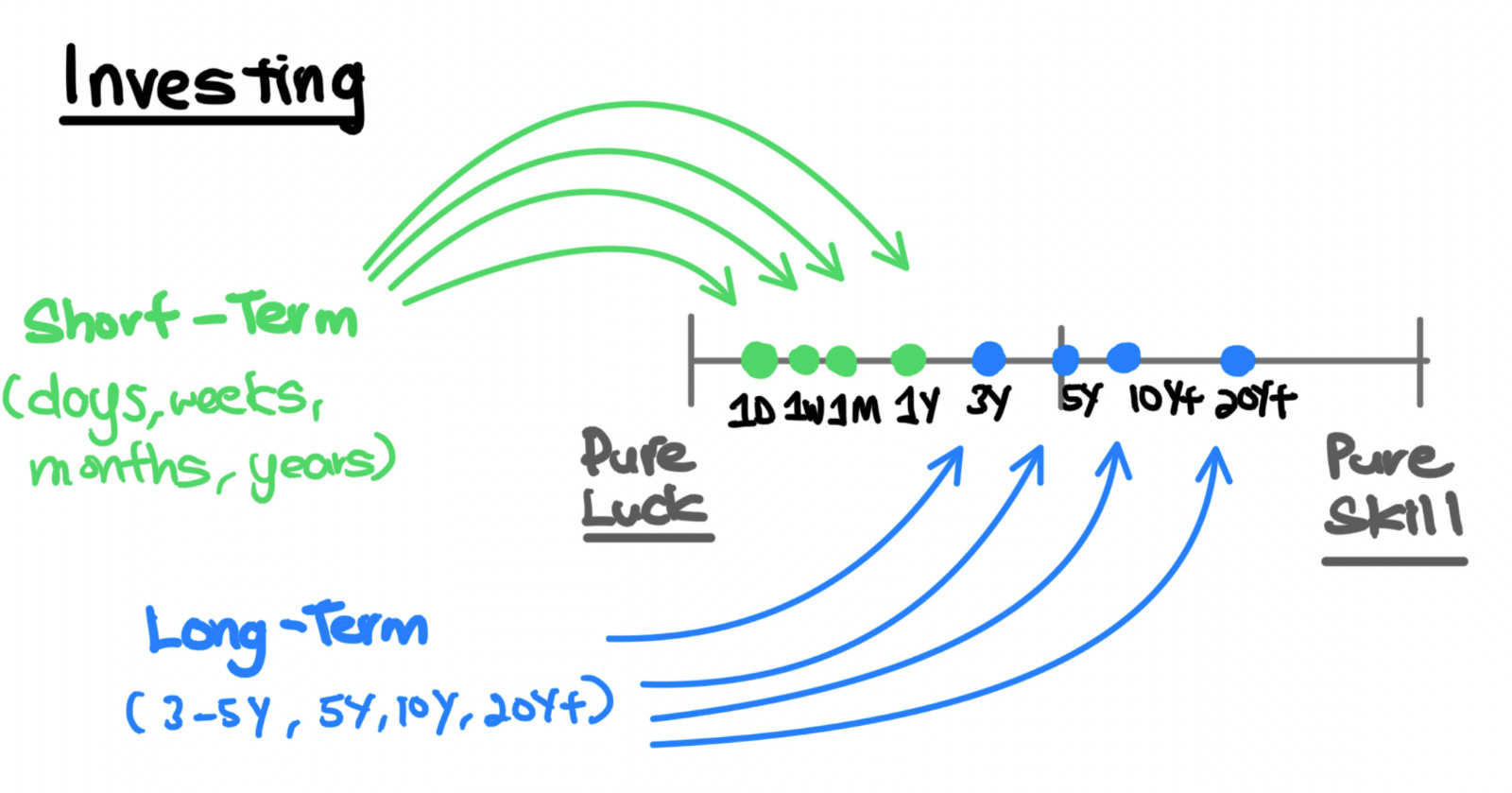
Seek out skin in the game, as it reduces moral hazard and sources of irreversibility. Be wary of advice from people and envying people without skin in the game. Skin in the game forces people to live with the time average rather than hide behind the ensemble average.
Thinking in Parallel Universes
Always apply the mental framework of thinking in parallel universes across time, not to single paths at a single moment.
Yet if time is stretched to infinity, everything becomes non-ergodic, which is not very helpful. Focus on a realistic, long enough time frame that matters to you.
Most people make decisions as they live in one universe. One path, one outcome, one bet. That’s not how reality works. Every decision you make today spawns a forest of possible futures branching outward simultaneously into the future. Ask not “will this work?” but rather ask if “across all the universes where I make this bet, what could happen?”
The Three Principles of Parallel Universe Thinking:
1. Judge decisions, never outcomes. A bad outcome from a good decision is just an unlucky universe. Do not let one universe rewrite your entire framework.
2. Survive the bad universes first. You cannot win the good ones if a single bad universe destroys you entirely. Ruin is the only outcome that matters because it ends your journey across all remaining universes permanently.
3. The best bets look wrong in most universes. Genius is seeing the universe others cannot yet imagine and holding to that conviction long enough to live inside it.
The ordinary investor fears the universe they are in. The extraordinary investor is already positioned for the one that has not arrived yet.
Think in forests, not trees. Think in universes, not paths. That is where the edge lives.
References:
Book: Ergodicity by Luca Dellanna
YouTube: Ergodicity and investing by Luca Dellanna
Article: A Big Little Idea Called Ergodicity by Taylor Pearson
Book: Antifragile: Things that Gain from Disorder by Nassim Nicholas Taleb
Previous Articles
Why Investing is like being Long Optionality?
Investing: Is it skill or luck?
My 12 Biggest Key Investing Takeaways from “Antifragile” by Nassim Taleb
The Winners You Missed Cost More Than the Losers You Picked.
The Convexity of Stock Investing.
The information contained in this article is for general informational purposes only. While every effort has been made to ensure the accuracy and reliability of the content, errors or omissions may occur. The author and publisher do not assume any responsibility or liability for any errors, inaccuracies, or omissions in the content, nor for any actions taken based on the information provided. Readers are encouraged to verify any information before relying on it and to seek professional advice as needed.

11 Mar 2026 | Eugene Ng | Vision Capital Fund | eugene.ng@visioncapitalfund.co
Find out more about Vision Capital Fund.
You can read our annual and quarterly letters for Vision Capital Fund.
Check out our book on Investing, Vision Investing: How We Beat Wall Street & You Can, Too. We believe that individual investors can outperform the market over the long term. The book chronicles our entire investment approach. It explains why we invest the way we do, how we invest, what we look out for in companies, where we find them, and when we invest in them. It is available via Amazon in two formats: paperback and eBook.
Join our email list for more investing insights. Our emails tend to be ad hoc and infrequent, as we aim to write timeless, not timely, content.
I love how you challenge the idea that investing is a zero-sum game by emphasizing survival over short-term gains. How can investors shift their focus from maximizing returns to ensuring long-term resilience?