


Most of the best leaders tend to be missionaries, not mercenaries, because the critical distinction separating the best is less about what they do than about what they believe in and how they behave. John Doerr, a venture capitalist at Kleiner Perkins, first introduced this concept back in 2000.
“Don’t start a company unless it’s an obsession and something you love. If you have an exit strategy, it’s not an obsession.” - Mark Cuban.
What are the differences between Missionaries and Mercenaries?
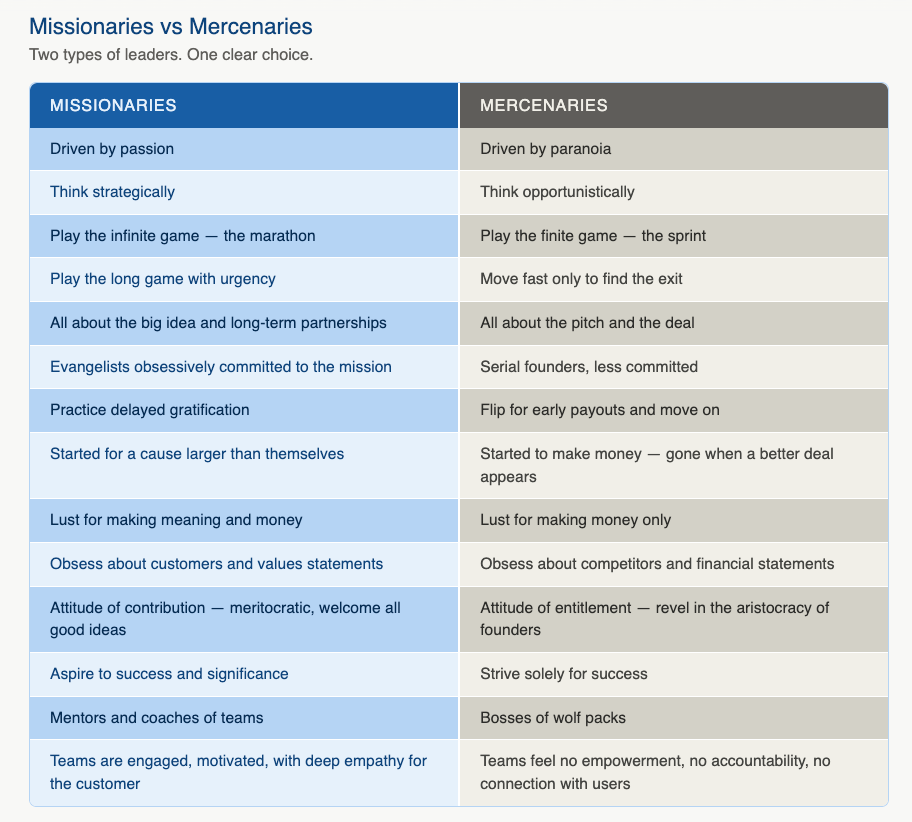
Missionaries are genuinely passionate and strategic. They are all about the big idea and long-term partnerships that land. They understand that innovation is a long-term endeavor, a marathon, not a sprint. They are evangelists, obsessively committed to the mission and practicing delayed gratification. They are playing an infinite game, but with the urgency of someone who knows time is not on their side. Missionaries have a lust for making meaning and money. They started for a cause larger than themselves, one worth dedicating a life to. They obsess about customers, fret over values statements, exude an attitude of contribution, are meritocratic, and welcome good ideas wherever they originate. Missionaries are focused on contribution and aspire to success and significance. Missionaries are mentors and coaches of teams. Teams of missionaries are engaged and motivated, with a deep understanding of the business context and have tangible empathy for the customer.

Mercenaries, on the other hand, are driven by paranoia and are opportunistic. They are all about the pitch and the deal, and are eager to sprint for short-term payoffs. They are playing a finite game. They tend to flip for early payouts, exit and move on, and are serial founders, which makes them less committed. They move fast, but only because they are looking for the exit. Mercenaries have a lust for making money only. They started to make money, and the moment a better deal appears, they are gone. Mercenaries obsess over competition, fret over financial statements, display an attitude of entitlement, and revel in the aristocracy of founders. Mercenaries are the bosses of wolf packs, focused on entitlement and striving solely for success. Teams of mercenaries feel no real sense of empowerment or accountability, no passion for solving the problem, and have little real connection with the actual users and customers.

The table below captures the differences at a glance.
Final words.
Which are you? A missionary or a mercenary? Which is the one that you prefer to work with you, work for you, or run a business or a startup that you own?
We tend to prefer leaders and work with missionaries, and generally find mercenaries less compelling. We want to invest in entrepreneurs and leaders who have the desire to change the world and the patience to see their ideas through. They have this infectious, tenacious grit, perseverance, and determination to stick it out, combined with resourcefulness and the ability to evolve and improve continuously.
We, too, after all, are missionaries investing in businesses led and run by missionaries.
References.
The information contained in this article is for general informational purposes only. While every effort has been made to ensure the accuracy and reliability of the content, errors or omissions may occur. The author and publisher do not assume any responsibility or liability for any errors, inaccuracies, or omissions in the content, nor for any actions taken based on the information provided. Readers are encouraged to verify any information before relying on it and to seek professional advice as needed.

11 Apr 2026 | Eugene Ng | Vision Capital Fund | eugene.ng@visioncapitalfund.co
Find out more about Vision Capital Fund.
You can read our annual and quarterly letters for Vision Capital Fund.
Check out our book on Investing, Vision Investing: How We Beat Wall Street & You Can, Too. We believe that individual investors can outperform the market over the long term. The book chronicles our entire investment approach. It explains why we invest the way we do, how we invest, what we look out for in companies, where we find them, and when we invest in them. It is available via Amazon in two formats: paperback and eBook.
Join our email list for more investing insights. Our emails tend to be ad hoc and infrequent, as we aim to write timeless, not timely, content.
Wonderful article Eugene! Helps to drive home the point that we should be looking for “missionary type” leaders and management in the companies we invest in