


This article first appeared in Vision Capital Fund’s Q3 2026 Quarterly Letter.
I recently read “Range: Why Generalists Triumph in a Specialized World” by David Epstein. It holds many lessons for investing and mirrors much of my own investing journey.
A popular myth is that early hyper-specialization is the shortcut to becoming elite. The truth is that it depends on the domain.
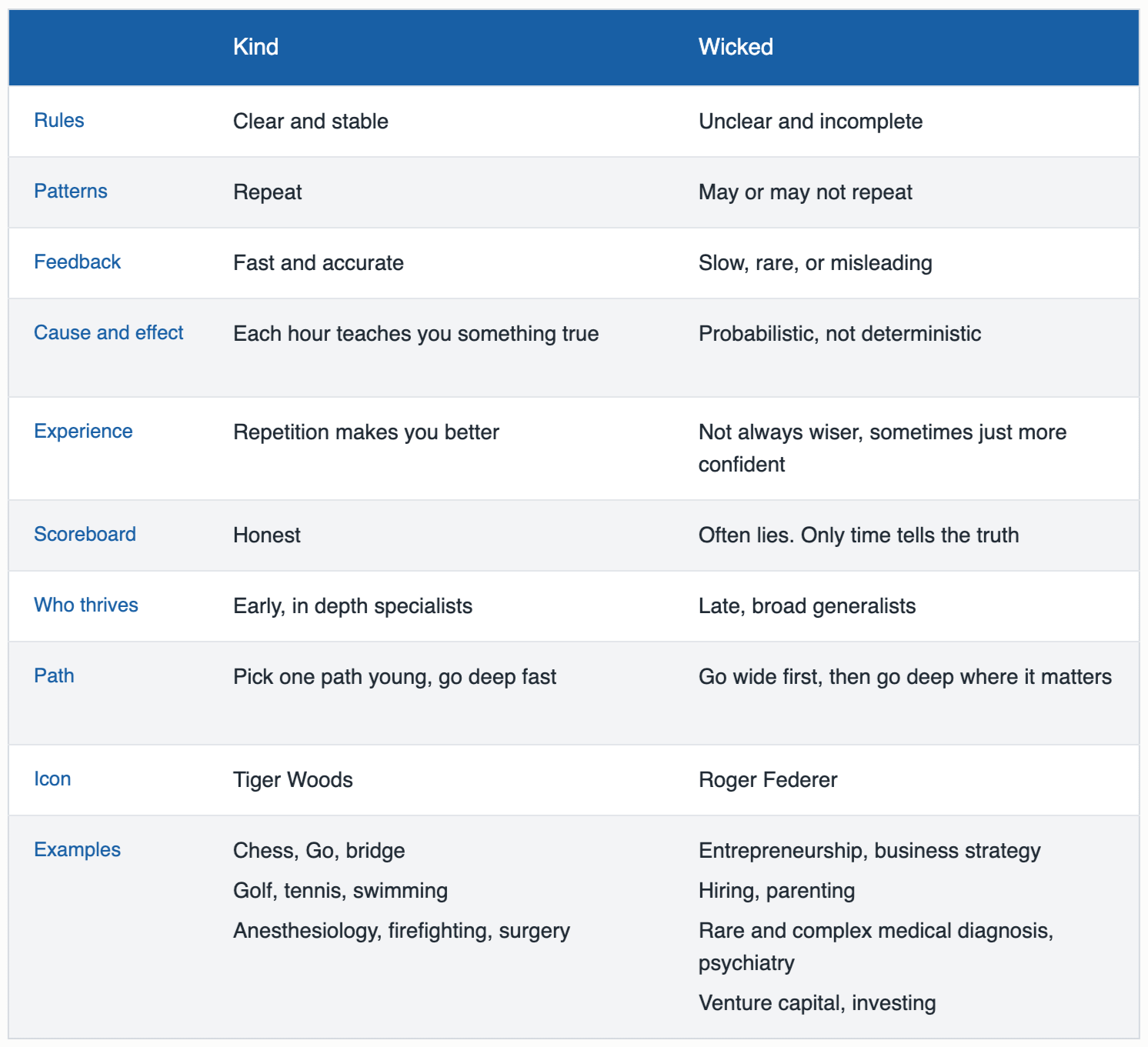
The psychologist Robin Hogarth split learning environments into two types: kind and wicked.
Kind learning environments have clear, stable rules, repeating patterns, and fast, accurate feedback. Here, ten thousand hours of practice works because each hour teaches you something true.
Think chess, Go, and bridge. Think golf, tennis, and swimming, sports built on repetition. Think anesthesiology (patient’s response shows up in minutes), firefighting (experienced firefighters read a burning building and see results quickly), and surgery (routine procedures).
Wicked environments are the opposite. The rules are often unclear and incomplete. Human behavior is involved. Patterns may or may not repeat. Feedback is slow, rare, or misleading.
Think entrepreneurship, business strategy, hiring, parenting, diagnosing rare and complex medical conditions, psychiatry (no clear tests, overlapping symptoms, slow, noisy, or missing feedback). Think venture capital (where you may wait years to learn if a bet was right) and investing (where a good process can lose and a bad one can win, in the short term).
In kind environments, repetition makes you better. In wicked environments, experience does not always make you wiser, sometimes it just makes you more confident. In kind worlds, the scoreboard is honest. In wicked worlds, the scoreboard often lies, and only time tells the truth.
The different environments shape the winning strategy. Early in-depth specialists pick one path young and go deep fast. They thrive better in kind worlds. Late broad generalists sample widely first, then go deep once they find their fit. They thrive better in wicked worlds.
Epstein’s contrast was Tiger Woods versus Roger Federer. Woods was swinging a golf club before age two. As a boy, Federer played many sports, including squash, skiing, wrestling, swimming, skateboarding, basketball, handball, tennis, table tennis, badminton, and soccer, but only gravitated towards tennis later in his teens.
Specialists go deep early. Generalists go wide first, then go deep where it matters.
In wicked worlds, breadth comes before depth. Build range by connecting ideas across different domains and fields. Dive in, imitate first, and learn the formal rules later. Some of the greatest musicians were self-taught and never learned to read music.
I was self-taught in investing too. I never trained under investment professionals or worked at a large, brand-name investment firm. I was never shaped by convention, so I could stay unbounded rather than bound by institutional habits. The best investors do not sound like everyone else. They find and develop their own voice.
I experimented. I looked for similar sounds and patterns in different places. I was genuinely curious. I read freely, listened carefully, consumed omnivorously. I was not seeking agreement. I wanted to aggregate different perspectives and synthesize them into hypotheses (mental models) to test, refine, and test again, until they could stand the test of time.
In wicked worlds, cause and effect is probabilistic, not deterministic. There are known unknowns and unknown unknowns. History rhymes far more than it repeats. So I think from the outside-in rather than from the inside out. I do not start with what is right or wrong. I start with the problem, and search for the best solution.
Because feedback is slow and noisy, wins and losses teach little in the moment. Their lessons only become clear with time and reflection. That is why I prefer to have strong convictions, loosely held. I would rather change my mind early than defend a wrong idea late.
Writing this, we realize that we had been walking this path before we knew its name. We never confined ourselves to one sector, one country, or one style. We have always searched widely, wherever excellence happens to live. We borrow ideas far outside finance, from economics, history, geography, sociology, psychology, and even physics to build more ways to think about the wicked, complex, adaptive environment we operate in.
When something truly matters, we go deep and seek, from first principles, what is timeless rather than what is timely. We did not choose to be generalists. Range found us first.

The information contained in this article is for general informational purposes only. While every effort has been made to ensure the accuracy and reliability of the content, errors or omissions may occur. The author and publisher do not assume any responsibility or liability for any errors, inaccuracies, or omissions in the content, nor for any actions taken based on the information provided. Readers are encouraged to verify any information before relying on it and to seek professional advice as needed.

17 Oct 2026 | Eugene Ng | Vision Capital Fund | eugene.ng@visioncapitalfund.co
Find out more about Vision Capital Fund.
You can read our annual and quarterly letters for Vision Capital Fund.
Check out our book on Investing, Vision Investing: How We Beat Wall Street & You Can, Too. We believe that individual investors can outperform the market over the long term. The book chronicles our entire investment approach. It explains why we invest the way we do, how we invest, what we look for in companies, where we find them, and when we invest. Available via Amazon: paperback and eBook.
Join our email list for more investing insights. Our emails tend to be ad hoc and infrequent, as we aim to write timeless, not timely, content.
Thought-provoking writing as always!